Seven small programs.
Each does one job, and cannot do another.
Oversight reaches an estate through a handful of small programs, each built for one purpose. Probes make the checks and send the results out. Agents sit on a host and say what is wrong with it. An echo reflects traffic so a link can be measured. The package agent patches Linux hosts. Two senders pick out the log lines that matter and send only those. None of them runs a command of your choosing, and none of them is a way in.
What each one is for.
Probe
Makes the checks, from GEN's locations in the UK, USA and Europe and from your own network, and sends the results out. Nothing connects to it.
Linux agent
Judges a Linux host where the context is, and serves a verdict in words: what is wrong, and how badly. It answers reads and nothing else.
Windows agent
The same for Windows 10 and Server 2016 onwards, judged the way Windows fails: commit charge, RPC and WMI slowing, services crash-looping.
Echo
Reflects a probe's traffic at the far end of a link, so loss and speed are measured in each direction, as often as you like.
Package agent
Tells Oversight what every Linux host has installed and waiting, and upgrades, removes or reboots when told. It only calls out.
Syslog sender
Takes the syslog from every device on a site's LAN, keeps it on the site, and sends only the lines your rules pick out.
Log sender
Does the same for a host's own logs: who logged in, what fail2ban banned, what last night's job reported.
| Program | Runs on | Talks | Can change the host |
|---|---|---|---|
| Probe | Linux servers and VMs, x64 and ARM64, or a container on a capable MikroTik router | Out only, over HTTPS | No |
| Linux agent | Linux on x64, ARM64 and 32-bit ARM, and Synology NAS units | Answers a probe's reads | No |
| Windows agent | Windows 10 and Server 2016 onwards, x64 and ARM | Answers a probe's reads; forwards the event log only where set on the server | No |
| Echo | Linux, Windows or macOS | Reflects what a probe sends it | No |
| Package agent | AlmaLinux and other EL, Debian, Ubuntu and Arch, x64 and ARM64 | Out only, signed | Upgrade, remove and reboot, nothing else |
| Syslog sender | One Linux machine per site, x64, ARM64 or 32-bit ARM | Listens for the LAN's syslog; sends out over HTTPS | No |
| Log sender | Linux hosts, x64, ARM64 or 32-bit ARM | Out only, over HTTPS | No |
Checks are made where they make sense, and the results come home.
A probe is the small program that makes Oversight's checks: pings, ports, web requests, SNMP, DNS, SIP, databases, mail, and the reads of every agent on this page. GEN runs probes in the UK, USA and Europe. Where a check only makes sense from inside, such as a hypervisor cluster, switches or internal services, GEN enrols probes on your own network as a probe group that only your organisation can see. A probe only measures: it reports what arrived, how long it took and, when something failed, what kind of failure it was. Every rule that decides what a reading means is held centrally.
- Groups, not single probes. A sensor is attached to probe groups, never to one probe. A group shares its sensors among its probes, so one probe failing does not take its sensors with it, and groups in different places vote, so one bad view is not an outage.
- It connects out, and nothing connects in. Over HTTPS and TLS 1.3, signed on every request with a key the probe made itself at enrolment. GEN holds only the public half.
- Nothing worth taking. Credentials are held in memory only and never written to the probe's disk, and a probe can be tied to its address.
- Updates that cannot brick. Length, hash and a test start are checked before a new build replaces the old one, canary first.
- Small enough for a router. A Linux server or VM on x64 or ARM64, or a container on a MikroTik router with the hardware to carry it, so a site can have a probe without a separate machine.
Not just the load average. What the load is made of.
The Linux agent samples its host every ten seconds and judges it there, where the context is: whether a filesystem was writable an hour ago, which links have ever had carrier, which disks are siblings in an array. What it serves is a verdict, green, amber or red, with what is wrong area by area in words the person fixing it can act on. A probe reads it, and a sensor on it needs two rules, not two hundred. It sends nothing of its own accord.
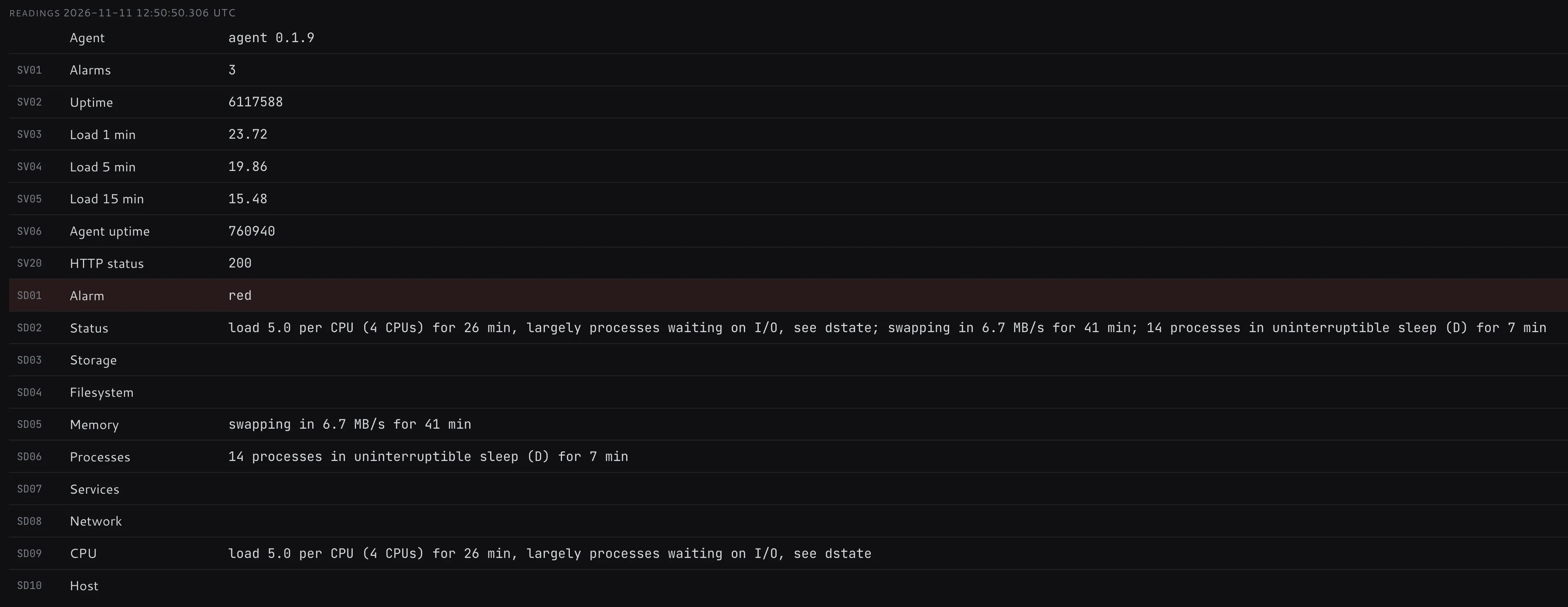
- Storage and filesystems. Arrays degraded or rebuilding, disks offline or slow, a mirror member far slower than its siblings, iSCSI, multipath and NFS, and every fstab entry mounted, writable, responsive and not about to fill.
- Memory, processes and services. OOM kills, memory pressure, swap being read back, zombies, hung processes, failed systemd units and the crash loops systemd keeps papering over.
- Network and the host. Lost links and bond members, a port renegotiated slower, a full conntrack table, the clock drifting, the hottest temperature sensor and a reboot.
- It waits before it raises. A problem must hold before it alarms and clear for as long before it drops, so a backup window never flaps, and a reboot gets five minutes for mounts and links to arrive.
- It answers when the host cannot. Every reply comes from what has already been sampled, so a hung NFS server or a stalled disk never leaves a request waiting.
- Read only, structurally. Its own unprivileged user, a token and an address allow list, no exec, no plug-ins and no write endpoint. It can be bound to a private mesh interface, off the public network altogether.
- One binary, everywhere. Servers and VMs, 32-bit ARM boxes and NVIDIA Grace Blackwell GPU hosts. On a Synology it installs, updates and is removed in Package Center, on DSM 6.2 and 7.
Windows fails in its own way. The agent watches for that.
The Windows agent runs as a service and judges the server it is on: how long a call to WMI or the service manager usually takes on this machine, which ports have ever had a link, whether a service is quietly crashing and being restarted. It finds for itself whether the machine is a domain controller or a Remote Desktop Session Host. It runs as its own virtual service account with no administrator rights, and nothing it serves is a secret, a process list or a user name.
- Commit, not just memory. Commit charge heading for its limit is the real out-of-memory on Windows, and can happen with physical memory still free. A leak is raised hours before it ends in a crash.
- Slowing before the collapse. RPC, DCOM, WMI and LSASS timed against what is usual on this machine, and on a domain controller, whether AD answers.
- Crashes and crash loops. Crashes with their stop code, services crash-looping, VSS failing and a broken domain trust.
- Events from a signed list. Windows events are matched against a list GEN signs, so a new Windows release is a new file, not a new agent. Name up to twenty events of your own, and it alarms when one appears.
- The event log, as syslog. If set on the server itself, it forwards the logs you choose to the syslog sender or any syslog server, with the channel, event ID and level as fields a rule can match. Off otherwise.
- Windows 10 and Server 2016 onwards. Desktop or server, x64 or ARM, with the same token and allow list as the Linux agent.
A ping says the link is up. An echo says how well.
The echo runs on any machine at the far end of a suspect leg: a LAN link, a leased line, a 4G or Starlink uplink, a tunnel between two sites. A probe at the near end sends it numbered packets and a known stream of bytes, so anything lost, reordered, duplicated or damaged on the way is counted, in each direction. Move it along the path, and the fault is found.
- Loss, split by direction. The echo counts what reached it, so loss on the way out is told apart from loss on the way back.
- Rain fade, not a handover. Scattered loss leaves out any single gap over 300 milliseconds, so a satellite handover does not read as a bad link and a dirty dish or heavy rain does.
- Throughput both ways. A TCP transfer up and then down, with the speed, stalls and retransmits for each direction, and every byte checked.
- Two echoes, one answer. One near and one far on the same path: a fault seen on the far one and not the near one sits between them.
- It reflects, and nothing more. It holds no credentials, knows nothing about its host to give away, and never replies with more than it was sent. One small binary for Linux, Windows or macOS.
- For private legs. Your LANs, WAN links, tunnels and backup circuits. It is not meant to face the internet.
Every package on every Linux host, found in one search and patched in one action.
A small agent on each Linux host tells Oversight what is installed, what is waiting, what has changed and who changed it. Oversight shows the whole estate in one list and one search, across distributions, and can tell a host, a group or a search result to upgrade, remove or reboot, with each host reporting back what it did. It opens no port and needs no SSH: every host calls out, and instructions come back in the reply.
- One search, the whole estate. A package name or pattern with an optional version condition, or a CVE id, across every host, one group or one host.
- Set it going at 22:00 and leave it. "Then reboot if needed" waits for the upgrade to finish, and counts as done only when the host checks in on a new boot, so "rebooted" means "came back".
- Every change, and who made it. "Upgraded by Oversight instruction, queued by J Smith" or "installed at a shell by root", not just "changed between two reports".
- Alarms for what should not happen quietly. A change no transaction explains, a repository added or changed, a kernel or BIOS change Oversight did not cause, and new cron jobs, timers and init scripts held for review.
- Upgrade, remove and reboot, nothing else. No install, no command, no new repository or key, at most one reboot an hour, and a floor it will not remove: the package manager, systemd, SSH, glibc, the running kernel.
- Virtualisation hosts kept apart. Proxmox, LXC, KVM, Docker and Podman hosts are left out of bulk upgrades unless chosen, and a Proxmox node is never rebooted.
A site's syslog stays on the site. Only what matters crosses the internet.
A normal site sends hundreds of thousands of syslog lines a day, nearly all of it firewall logging, monitoring systems logging in and routine chatter. The syslog sender runs on one Linux machine at the site, takes the syslog from every router, switch, firewall and UPS card on the LAN, and keeps all of it in a file per day. Rules you write pick out the few lines that matter, and only those go to Oversight, every five minutes. On a good day nothing is sent at all.
- No rsyslog, syslog-ng or logrotate. It has its own listener, and writes and rotates its own files.
- Counted, not shipped. Count rules tally every line by rule and by source, whatever is sent, so a surge of failed logins shows even when not one of its lines leaves the site.
- A silence is never a quiet day. A stretch when nothing arrived is marked among the lines, and GEN is told when a sender stops.
- Windows too. The Windows agent can forward its event log to it, so the same rules pick out the events that matter.
- Unprivileged once installed. It runs as a user that may listen on the syslog port and do nothing else, and only ever connects out, with a token GEN has registered.
Who logged in, what fail2ban banned, and what last night's job said.
The log sender reads a Linux host's own logs: log files followed through rotation, the systemd journal, or a report piped in from cron. Like the syslog sender, it picks out the lines that matter with rules you write, and sends just those every five minutes. Each thing it sends is a channel of its own, so one host can send its logins, its bans and its backup report separately.
- Ready-made flavours. Successful logins by SSH, su, the console and Cockpit, and every fail2ban ban and unban, found on RHEL, Debian or the journal alike. GEN adds more as they are asked for.
- One command for an estate. A host without the log a flavour reads skips it, so the same install can be run everywhere.
- Into the same place. The same rules, limits and Logs page as the syslog sender, and one token per host, shared by every channel on it.
- Tried before it is trusted. A dry run over a month of real log shows what a rule would send before it is relied on.
AMS puts the Windows agent there for you, and keeps it there.
AMS is GEN's asset management system for the Windows machines in an estate GEN looks after. Its own agent, installed by GEN, keeps an inventory of each machine and applies the policy, software and files set for its group. Tick Oversight on a machine, and AMS installs the Oversight Windows agent with a token of its own and your probes as the only addresses allowed to read it, reinstalls it if the service goes missing or stops, keeps it on the current release, and removes it again when the tick comes off.
- An inventory that keeps itself. Hardware, software, updates, security and network state from every machine, refreshed daily and after each reboot.
- Policy without a domain. Group policy for workgroup machines, which have no domain to give them any, withheld by itself once a machine is joined or enrolled. Software and file drops by group, on every machine.
- Planned maintenance. Recurring schedules per machine raise a HelpDesk ticket when the work is due, with the machine's details, location and remote access in it.
- Signed both ways. Every request is signed by the machine and every reply by GEN, and a machine registers once, with a single-use key bound to its hardware.
AMS comes with GEN's managed service rather than as a separate sign-up. Talk to us about it.
Find out from Oversight, not from your users.
Register as a client and an account manager will walk you through the early steps, with no commitment at all. Or talk to an expert first.
The agents are one part of it. See what else Oversight covers.